
How to License Human-Verified Arabic Datasets for Commercial AI Projects
A practical guide to licensing human-verified Arabic-Chinese bilingual data for LLM training, game localization, and conversational AI.
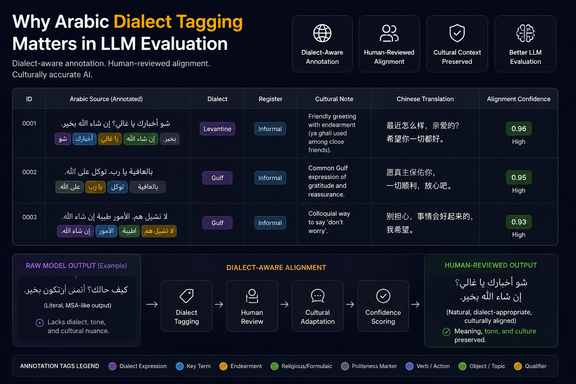
How to Evaluate Arabic LLM Outputs for Dialect Consistency: A Step-by-Step Guide
Learn how to test Arabic LLMs for Gulf, Levantine, and Egyptian dialect accuracy. Includes evaluation metrics, annotation templates, and failure case examples.
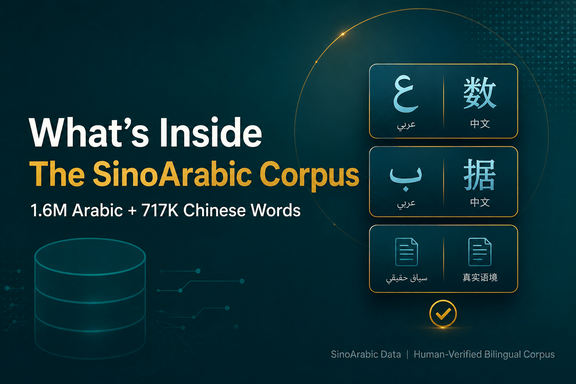
What's Inside the SinoArabic Arabic-Chinese Corpus? A Technical Breakdown of 1.6M Words
A detailed technical walkthrough of the human-verified 1.6M Arabic + 717K Chinese word corpus with dialect tags and annotation layers.

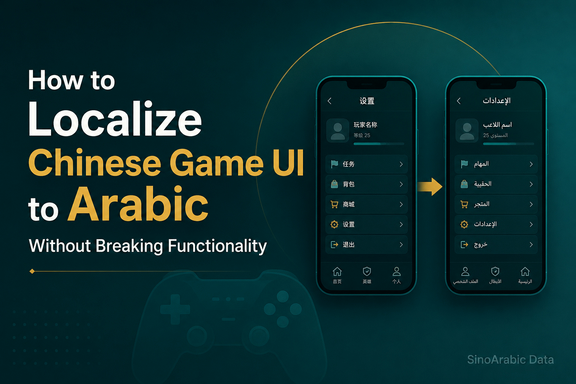
How to Localize Chinese Game UI into Arabic Without Breaking Functionality
Preserve dynamic parameters, UI constraints, and cultural meaning when localizing from Chinese to Arabic. Best practices with real examples.

When Token-Level Agreement Masks Meaning-Level Failure: Alignment Methodology for Arabic NLP
High BLEU scores can co-exist with annotations that fail on idiom, register, and cultural reference. Learn how to catch these failures.
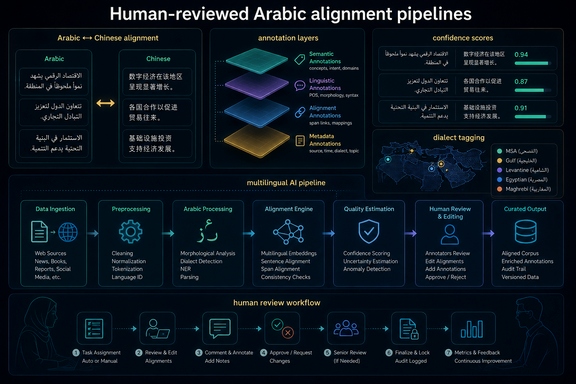
Gulf vs. Levantine: Labeling Dialect in Training Data
Why collapsing Arabic dialect variants into a single label produces classifiers that generalize poorly across regions → and how granular dialect tagging changes model behavior.
What Makes a Joke Survive Arabic Localization?
Pragmatic humor depends on shared cultural reference frames. Three localization failure cases and the annotation decisions that would have prevented them.

Building Evaluation Sets That Test Cultural Reasoning in Arabic LLMs
Standard benchmarks rarely probe whether an Arabic LLM understands cultural implication. A methodology for constructing evaluation sets that do.

Fine-Tuning Chinese-Arabic Large Language Models: Why Models Collapse Without Human-Verified Data
Why synthetic data causes model collapse in Chinese-Arabic LLMs, and how human-verified data prevents it. A technical deep dive.